
Behind the Curtain
Cortine, 'a piece of cloth to separate one part of a room from another' (French, 14th c.)
Some of us prefer not to know what goes on behind the curtain. For those who are curious or technically inclined, here are some videos and links.
What happens to a body after it dies?
This video by a registered nurse describes (in words, not images) the changes that a body goes through after dying.

How is organ donation done?
This video from McMaster University describes the process and criteria for organ donation.

How is an autopsy done?
In this lecture from the Royal College of Pathologists, a hospital pathologist presents a "live autopsy" (with a live model and no scalpels) to describe the steps of an autopsy from start to finish.

What happens to a body that is donated for medical education and research?
Dalhousie University's Human Body Donation Program teaches medical students about anatomy and helps them develop surgical skills. Each year, approximately 185 body donations are accepted, but not individuals with a communicable disease, a body mass index (BMI) over 34, or a major trauma. To qualify for donation, your body must remain intact; only your corneas can be removed for transplant. Your next of kin also must agree to your donation.
Prompted by a call from your doctor, the Nova Scotia Medical Examiner decides on admission. In case you're not admitted, you should have a backup plan for when the time comes. Assuming that you pass the first steps, there are two routes:
-
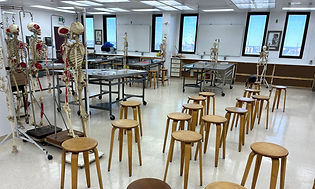
30% of donors receive long-term "anatomical embalming." Then, after three months of cooling in the basement morgue of the Tupper Building, they move up to the anatomy lab on the 14th floor. This big, bright room has many windows, with vistas of Halifax and the ocean in all directions. By now, there's no need to stay cool, as further decomposition can't happen. Some bodies are dissected by the staff for demonstration in anatomy teaching. Others are dissected by Medical Science students in ANAT 4010 or Dentistry students in DENT 1113 to develop their clinical skills. Bodies are wrapped whenever the work pauses. It takes about four months for a small team of students to do a complete dissection. Donors retire after 1–3 years. This video from a private anatomy institute in Salt Lake City describes how an anatomy lab works.
-
70% of donors receive short-term "soft embalming" and stay cool in the morgue. Periodically, they visit the new Clinical Cadaver Program on the 14th floor, where medical students develop their surgical skills. Donors retire after 4–6 weeks.
When your body is no longer needed for education and research, it's cremated. The ashes are then interred or returned to your delegate at no cost. Each year the university hosts a memorial event to honour donors. Dalhousie also has installed memorial benches in several Halifax cemeteries.


What happens during cremation?
This video from Idaho describes the equipment and process of cremation.

What happens during aquamation (alkaline hydrolysis)?
This video describes the equipment and process of alkaline hydrolysis.

How is embalming done?
In this video, a funeral director gives a guided tour of a funeral home, using a mannequin to illustrate the steps for embalming a body.
First, the facial features are set, using modeling techniques. Four embalming techniques are then used: arterial embalming, which injects formaldehyde-based chemicals into a major artery and drains the blood from a major vein; cavity embalming, which removes fluids from hollow organs and replaces them with chemicals; hypodermic embalming under the skin to fill blood vessels that were missed by arterial embalming; and surface embalming to adjust the body's external appearance. Embalming is followed by grooming, using makeup techniques to compensate for the body's gray colour and to make the head and hands look lifelike for viewing.
There are different types of embalming for different purposes. Anatomical embalming preserves a body for medical education, using high concentrations of chemicals over three months, so that it will be preserved indefinitely without refrigeration. Mortuary embalming (at a funeral home) needs to preserve a body for only a short time, so the chemical concentrations are lower. A third type, soft embalming, uses an even lighter process with different chemicals that enable delicate tissues to remain pliable for surgical training.

How is a casket made?
Caskets are made in different ways, using different materials:
-
Willow's Bend Collective, a small company in Antigonish, shows how they make a woven willow casket by hand.
-
A former priest in Minnesota shows how he builds a simple pine casket.
-
Episodes of How It's Made show more industrial-scale operations for making elaborate wood caskets and elaborate metal caskets.

How are burial vaults and grave liners made?
A burial vault is a multi-layered concrete box to enclose a casket and seal it from the elements underground. It's made by casting concrete around laminated interior materials such as copper and plastic. Later, a butyl sealant attaches the lid to the box, completing the enclosure.
A grave liner is a simpler, unlined concrete box that a cemetery may require to enclose a wooden casket, so that the lid doesn't collapse due to the weight of earth on top. Unlike a burial vault, it's not fully sealed. Grave liners and burial vaults are lowered into the ground using a manually operated frame or a cart with a powered hoist.

How are graves dug?
Digging a grave by hand requires a few tools, some practical skills, an eye for precision, and plenty of physical labour. Digging a grave with a backhoe or a mini-excavator involves bigger tools, a different kind of precision, and less physical labour. Digging a grave is referred to as "opening"; filling it in is called "closing."

How is a stone marker made?
Older markers were made of limestone, sandstone, or marble: sedimentary rocks that were easy to carve by hand but prone to weathering. In Halifax, most stone markers are now made of granite, a harder igneous rock that requires industrial carving and finishing. Different granite colours (black, gray, pink, and red) come from different locations around the world. A company in Windsor describes qualities of granite from nine different sources: Quebec, Ontario, Vermont, and countries as far away as India.
After granite is quarried and sawn, it goes through various steps from design to installation. Lettering and images can be engraved with power tools or sandblasting or etched with a laser. Installing a concrete foundation to a depth below the frost line (1.2 metres deep in Halifax) ensures that a vertical stone and its stone base will stay upright.
Another option for a marker is to cast the lettering as a bronze plaque and attach it to a stone base.

How is a columbarium made?
The stone or concrete frame of a columbarium is made in a factory. At the cemetery, it's installed with a crane onto a concrete foundation. The columbarium includes many small niches, each for one or two cremation containers. Using different combinations of locking hardware and tools, the niche covers on the front can be removed for engraving.

How long does it take a body to decompose?
Forensic scientists at some universities (including one in Québec) use an outdoor body farm to understand how bodies decompose in different conditions. This helps solve homicides and accidents. Out in the open, a body can decompose to bones in as little as two weeks, depending on ambient conditions, but two months is more common. A buried body can take up to ten years, depending on whether it was embalmed with fluids, whether it was enclosed in a sealed casket, the casket material, the ground temperature, and the type of soil at that depth. The same applies inside a mausoleum, where it may cause environmental pollution, despite openings for ventilation and drainage.
