Ways to Go in Halifax
Weg, 'road along which goods are transported' (Old High German);
Halh-gefeaxe, 'area of coarse grass in the nook of land' (Old English)
What should I do with my body?
Based on your funeral plan, your next of kin (or delegate) will make arrangements for your disposition. (Your funeral plan should be separate from your will, which won't be read until later.) If you didn't already prepare a funeral plan, your delegate's job will be harder. Either way, here are some tips that could be handy.
First, you need to choose from two formats:
-
remaining as a full body (usually burial)
-
reduced to ashes (typically cremation)
In Canada, 75% of us are choosing cremation. Reasons include: lower cost, less available land for cemeteries, less religious affiliation, and less family rootedness to a particular place. If you have different priorities (religious, environmental, etc.), you may opt for a certain type of burial instead.


If I choose full-body disposition, what are my options?
Full-Body: Earth Burial
Burial has been practiced by humans for at least 120,000 years. Reasons have included: bringing closure by letting the body disappear; preparing the person for an afterlife by placing the body below the surface; protecting the body from scavengers; preventing odours due to decomposition; and returning to the earth at the end of a life cycle.
Burial depth is not the legendary six feet. Two feet of earth on top is sufficient for sanitary purposes. Earth is not uniform; soil nearer the surface has more biological activity, so it promotes decomposition better than deeper subsoil. Cemeteries in Halifax can set their own rules for depth.
A 40" x 120" burial plot in a municipal cemetery may be used for two stacked burials, on condition that the first burial was sufficiently deep, or that 40 years has passed and the first burial did not use a steel casket or a concrete vault (article 20).
All burials require a burial permit from the provincial Department of Vital Statistics. Burials are limited to cemeteries; Halifax's land use by-law doesn't allow you to be buried on your own property (although this may be possible on a rural property outside the city).
Coverings and Caskets

globalnews.ca/news/10318631/life-beyond-death-digging-deep-into-the-growing-trend-of-green-burials/

soils.usda.gov/education/resources/lessons/profile/profile.jpg
A body typically is wrapped before burial. Options include increasingly protective layers: a cloth shroud (which has a long history); a cardboard container (usually for cremation); a basket woven from willow rods; an untreated softwood box; a treated hardwood casket; and a heavy-gauge metal casket with or without a rubber gasket or butyl seam to seal it. The first four acknowledge decomposition; the last two resist it. The thickness of metal in steel caskets ranges from 16 to 20 gauge, the same as an SUV.

ebay.ca/itm/265648598170

millvalleyfuneral.com/cremation-caskets-and-containers

naturalendings.co.uk/shop/willow-eco-coffins/golden-willow-coffin-traditional-shape/
heritagefuneralcentre.ca/our-services/casket-selections

victoriaville.co/en/hardwood-caskets/oak

dignitymemorial.com/en-ca/funeral-homes/virginia/williamsburg/nelsen-williamsburg/5088/costs

Although the words "coffin" and "casket" may be used interchangeably, they are different in their form and history. Coffins are six-sided and narrower at the head and feet, whereas caskets are larger, rectangular, and more abstract. Coffins have become rare in North America.
This guide to buying a casket describes different types. Most North American caskets are made by Batesville (based in Batesville, Indiana) or Victoriaville (plant in Victoriaville, Quebec). You can also make your own or purchase a readymade kit that can be used as a bookcase until you need it.

In Ghana since the 1940s, personalized "fantasy coffins" have been the centrepiece of some memorial celebrations. Someone's lifetime passion or livelihood might prompt the construction of a colourful figurative coffin (fish, lion, airplane, Coke bottle, Marlboro packet, Mercedes, gas pump, camera, track shoe, etc.) to launch the person memorably into an afterlife, perhaps assisted by dancing pallbearers. This video shows how they are made.
A woodworking company in the UK has been doing the same for the past twenty years. If you wouldn't be caught dead in an extravagant, sombre casket from a North American manufacturer, you might consider a lighter approach. Likewise, if you opt for a stone marker, you could join many others who couldn't resist a punchline. Canadian actor Leslie Nielsen used RIP as a pun for a final fart joke.
Burial needn't include a casket. Green burial and Muslim burial simply wrap the body in cloth. Orthodox Jewish burial uses a cloth shroud and a porous, untreated softwood casket without metal hardware. Each of these customs avoids embalming so that natural decomposition is not delayed.

theguardian.com/world/gallery/2013/feb/07/ghana-coffins-in-pictures

crazycoffins.co.uk/
The weight of earth on top of a wooden casket can cause the lid to cave in. If you walk through a cemetery and notice a depression in the ground, that may explain it. To prevent collapse, some cemeteries in Nova Scotia require that a wooden casket be enclosed in an additional concrete box: a grave liner. A more elaborate option is a lined, sealed, multi-layer concrete burial vault.

wilbert.com/burial/
Full-Body: Entombment in a Mausoleum
In a modern cemetery, a crypt is generally an above-ground enclosure for a casket, located in a small mausoleum with openings on the front like a filing cabinet. Like units in an apartment block, crypts can be stacked and combined into different mausoleum arrangements.
A mausoleum also can be a small building with a front door, a vestibule inside, and crypts for family members. It's usually a freestanding monument surrounded by a natural landscape, but in tight urban cemeteries, many small ones may be grouped together like houses along a street. Some cities (but not Halifax) have larger public mausoleums for unrelated individuals.
Crypts and mausoleums are typical in New Orleans, which is prone to flooding and not suited to burials. In other cities, they may suggest a desire not to be buried in the earth - or not to die at all. A body in a mausoleum decomposes, dehydrates, and mummifies, whereas a buried body decomposes into the earth. The design of a mausoleum may attempt to reinforce one's legacy. Grand mausoleums are common in cities with celebrities such as New York and Los Angeles, but pale in comparison to the Taj Mahal and Egyptian pyramids.
Crypts and mausoleums are rare in Halifax, so you'd have to acquire a place in a cemetery and install your own. Above-ground crypts typically have ventilation and drainage features to deal with odours and leaks. Some cemeteries and some religions don't allow mausoleums, but they are permitted in Fairview Lawn Cemetery.

columbariumusa.com/cemetery-crypts/

mausoleums.com/pros-cons-mausoleums/
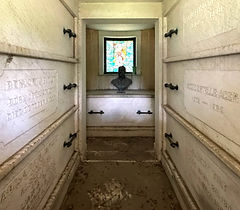
reddit.com/r/CemeteryPorn/comments/15fh4hd/inside_the_tilt_family_mausoleum_woodlawn_bronx_ny/
Full-Body: Donation for Medical Education and Research
Dalhousie University's Human Body Donation Program is operated by the Faculty of Medicine's Department of Medical Neuroscience. You can apply to donate your body to the university to help medical students learn about anatomy and develop surgical skills. For more details, look Behind the Curtain. This program is separate from Nova Scotia's organ and tissue transplant program (Legacy of Life), which records your donor choice on your Nova Scotia health card. You can't do both. If your organs and tissues are declined for transplant, you can still donate to Dalhousie.
Brain: Donation for Medical Research
The Maritime Brain Tissue Bank, based in the Faculty of Medicine at Dalhousie University, also welcomes donations. You can apply to donate your brain to help researchers around the world study dementia and other neurological diseases. Following a medical brain autopsy at a hospital, you can proceed with your plans for burial or cremation.

Andreas Vesalius, plate from De humani corporis fabrica (1543)

commons.wikimedia.org/wiki/File:Brain-outline-lateral.svg
Body Part: Donation for Cadaver Dog Training
Are you a dog person? If you receive an autopsy from the Nova Scotia Medical Examiner Service, they may contact your next of kin about donating a small part of your body to the RCMP's Human Remains Detection Program. This would be used to help train a cadaver dog to locate human remains during searches for missing persons. This program in Nova Scotia was the first in Canada, and Doc was the first graduate of the program.

globalnews.ca/news/2558066/meet-doc-the-first-rcmp-cadaver-dog-in-canada/
If I choose cremation, are there additional options to consider?
Cremation is simpler. The only options are at the very end of the process.
Historical evidence of cremation dates back to around 20,000 BCE in Australia, followed by China, Persia, Europe, and India. Cremation in the West has been practiced for around 5000 years. After 400 CE, cremation was prohibited by Christianity, which insisted on earth burial instead.
Cremation began to return in the 1870s, when an enclosed cremation chamber was invented in Italy. Advocates for cremation cited various reasons: avoiding the spread of disease, avoiding the pollution of ground water, reducing funeral expenses, and disposing of a body quickly. Elsewhere - especially in India - open-air cremation is a ritual step toward a person's next life. Cremation is now permitted by most religions, including Christianity. It has grown steadily and become the most popular option in Canada.
A modern crematorium furnace (also called a retort or chamber) is made from multiple layers that retain heat inside while keeping the exterior cool. From outside to inside, those layers are steel plate, ceramic fibre insulation, and aluminum-silicon refractory brick. It also has an electrical system, a fuel system for natural gas or propane, and an exhaust system.
cremsys.com/services/inspection-preventative-maintenance/


scattering-ashes.co.uk/traditional-indian-hindu-sikh-cremation-urn/
The cremation process is described in this video. The first step is to remove any pacemakers (the battery can explode) and prostheses. The body and a stainless steel numbered ID disc are placed into a flammable wood or cardboard container. It slides into the enclosed furnace, where the temperature rises slowly to 760–870°C.
After 2–3 hours, water vapour and gases have been exhausted into the air, and the body is reduced to 4–6 pounds of calcified bone (mostly calcium phosphate). The bone fragments typically are called ashes, but are not like wood ashes after a bonfire. After they have cooled, a magnet removes any metal implants and fillings for recycling. The ashes then go into a cremulator that reduces large bone pieces to 1/8".
The final ashes are inorganic and inert, but very alkaline. They are placed into a temporary or permanent container: a plastic box, a wooden box, an urn, etc. From there, they can go to many different places, as noted on the Final Destinations page.

goinghomecremations.com/laws-for-cremation-in-florida/

diytrade.com/china/pd/20903488/human_emains_cremated_rgrinder.html

inremember.com/post/bones-of-contention-understanding-cremation-and-its-historical-cousins
Columbaria for cremation containers are becoming more popular in Halifax. In 1994, an indoor columbarium was built in St. John's Cemetery at the location of the former church. Freestanding columbaria have been added more recently to Holy Cross Cemetery, Mount Olivet Cemetery, and Fairview Lawn Cemetery. A columbarium will be installed soon in Camp Hill Cemetery, so you could hang out with Alexander Keith, Joseph Howe, and Viola Desmond.


What kinds of paperwork are needed?
-
After you die, your last attending physician fills in a registration of death form (which includes a "Medical Certificate of Death" section) and sends it to the Nova Scotia Medical Examiner Service. (In your case, due to your autopsy, the Medical Examiner fills in the whole form for you.)
-
The Medical Examiner also fills in a cremation approval form to indicate that no further investigation of your death is needed. (Despite the name, this refers to both burial and cremation.) All of your forms are placed into the envelope that is attached to your body bag. Everything is transported to the funeral director at your funeral home or crematorium.
-
The funeral director (who also serves as a Division Registrar of Deaths for the Department of Vital Statistics) obtains information about you from your next of kin and forwards your Registration of Death form to Vital Statistics. This needs to be done within 48 hours after you die.
-
Vital Statistics prepares a burial permit and sends it promptly to your funeral director. (Despite the name, this is used for both burial and cremation.) If you plan to have a religious service, a copy is sent to your clergy.
-
You can now be buried or cremated.
But that's not the end of the paperwork.
-
Vital Statistics registers your death in the provincial records. This takes 4–6 weeks. They classify your cause of death according to the World Health Organization's International Classification of Diseases, 11th revision.
-
Your executor refers to the Canadian government's tips, What to Do When Someone Dies. This blossoms into more paperwork for banks, insurance companies, Canada Pension Plan, Canada Revenue Agency, etc.
-
Your executor checks with the institutions you dealt with to find out which document each one requires to wrap up your account: a long-form death certificate from Vital Statistics, a short-form death certificate from Vital Statistics, or just a copy of a statement of death from your funeral director. Your executor then submits a death certificate application to Vital Statistics for the correct number of forms. A response takes 4–6 weeks.

Christa Dodoo / Unsplash